Scarification: All That You Need To Know
Scarification is a process of permanently altering the texture of pare by cut through sheets of skin to create a scar on purpose. A mixture of techniques tin exist employed, including cutting, scratching, and burning.
In that location is a deep history to this tradition dating back to West African history where incisions are made—either by cutting or branding—to communicate cultural expressions through permanent scars. According to tradition, scarification signified a person's identity, including a person'southward position inside their community, an developed's passage into machismo, or a connection to a tribe. In other words, the idea came from the desire to save the human body from painful tattoos rather than wanting to harm it.
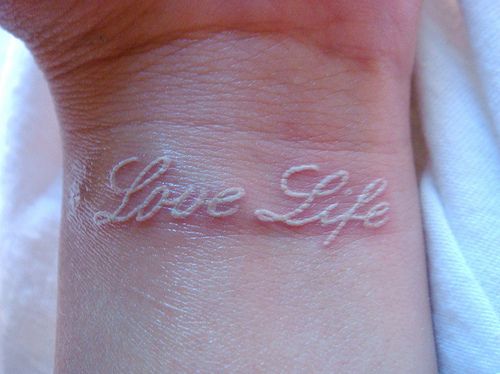
In scarification, the pare is opened up so that skin tissue can grow along the drawn lines. Its lighter color is considering information technology is damaged skin that tends to grow back lighter and then that it will dissimilarity with darker peel tones. Also, it was common to irritate healing scars even further past rubbing them to leave a more distinct scar.
We will learn everything about scarification as a body modification and what should be taken care of when nosotros exercise it. Thousands of people apply this method every year, and so yous should learn everything y'all need to about it before you try it. If y'all would like to discuss this process in more depth, we strongly propose that you brand an engagement with your doctor.
Reasons of Scarification
Anthropologists have debated long and hard nearly what constitutes a boundary. Introducing rites of passage into his description of tattooing, scarification, and painting in 1909, Van Gennep described these transformations as rituals of passage. Levi-Strauss described the body in 1963 as an imprinted surface that is waiting for the culture to banner. Turner (1980) start introduced the term "social skin" in his analysis of how Kayapo culture was synthetic and expressed through the individual body. An important theme in anthropology that has been nowadays since its inception is that of boundaries between the individual and society, between societies, and between representation and feel.
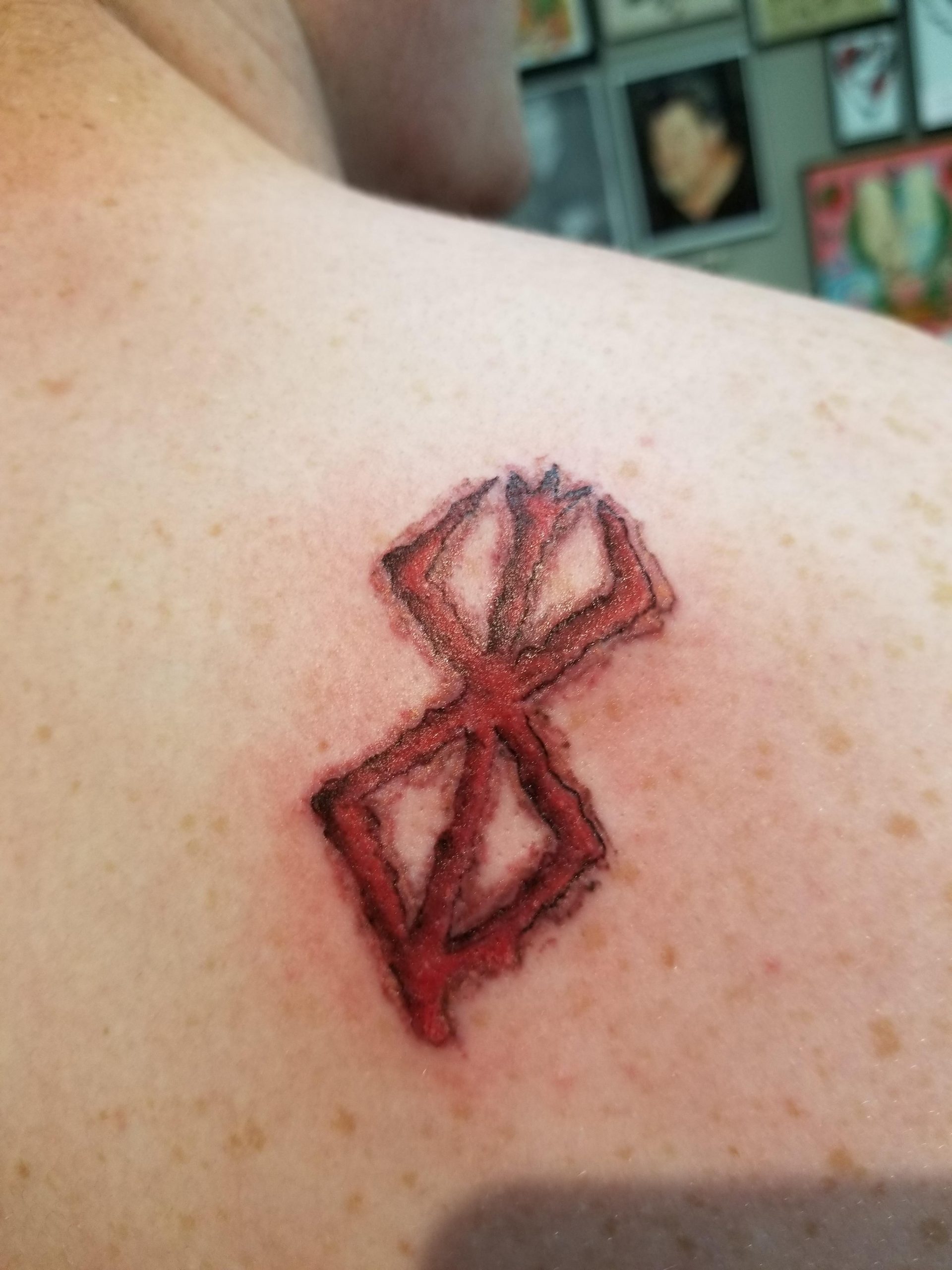
The behavior ecology of scarification is currently based on four competing hypotheses: (1) a rite of passage, (ii) a traumatizing procedure, (three) a sexually selected character that is devoid of adaptive traits, or (4) an adaptive pathogen-induced selection process. Additionally, scarification may also be motivated by aesthetic, religious, or social factors. Scarification, for example, has been widely used by many West African tribes every bit a fashion to marker significant life events, such every bit the puberty and marriage of girls and women. Women who have to scar on their abdomen may announce a willingness to be mothers. This is considering their ability to bargain with the pain of scars indicates they are emotionally mature and prepare to become mothers. The use of permanent torso markings is also used to convey complex messages about identity. Permanent torso markings may highlight fixed social, political, and religious roles. Papua New Guinean boys undergo scarification that resembles crocodile scales to mark their transition from childhood to manhood, a anniversary rooted in the belief that humans evolved from crocodiles. Whenever tattoos, scars, brands, and piercings are caused voluntarily, they let people see an private'southward autobiography on their body.
Scarification is generally not included in the activities of the tribe. Members who avert scarification often notice themselves excluded from their guild. A grouping member defective the typical characteristics is not supposed to take full standing in their society; they are also not considered as capable of meaningful behavior, such equally greeting others, commanding, and stating one's opinion. Scarification tin thus transform partial tribe members into normal states completely accepted by the group. Besides extensive and intricate greetings, scarification is a not-typical language that allows a person to communicate fully, an chemical element that is needed to exist considered a normal member of the group.
- Normally, scarification is more noticeable on darker-skinned people than on tattoos.
- During the scarification process, endorphins are released that can induce euphoria.
- Scarification is often used to demonstrate pain endurance. Young males demonstrate strength and field of study through the endurance of scarring, especially in tribes where male members play the role of hunters and warriors. A person who has had their flesh torn or cutting should exist less likely to fear a wild animal'due south teeth or the tip of an enemy's spear afterwards they accept experienced the sensation of torn or cut flesh.
- Among Ethiopian Suri men, scarification is used as a sign of warfare after they slay someone from an enemy tribe, whereas among Mursi women it is used to enhance their sexual experience past attracting the opposite sex. Ekoi people of Nigeria believe that scars serve as a type of currency on the journey to the afterlife.
- Sudanese tribes consider scars medically benign. Scars above and around the eyes are thought to improve eyesight, while scars on the temples aid relieve headaches. There are groups in Northern Ghana such as the Dagomba who employ scarification as a method of treating certain illnesses such as convulsions, measles, pneumonia, stomach pains, and so on. Every bit these diseases are believed to originate in the claret, a traditional healer cuts the pare to obtain a pulverisation or potion that is then applied directly to the wound, assuasive the poison to enter the bloodstream.
- In addition to scarification, survivor status can exist changed through scarification. Individuals undergo a variety of ritual death and rebirth, and they redefine the relationship between themselves and society in this fashion.
- In that location are some African tribes or ethnic groups that tin be identified by their "markings" in certain regions. There are many tribes in Northern Ghana that use the markings, which include the Gonjas, Nanumbas, Dagombas, Frafras, and Mamprusis.
Scarification is a tradition amongst some ethnic groups in sub-Saharan Africa, such as the Gonja, Dagomba, Frafra, Mamprusi, Nanumba, Bali, Tɔfin, Bobo, Montol, Kofyar, Yoruba, and Tiv people of Due west Africa, and the Dinka, Nuer, Surma, Shilluk, Toposa, Moru, Bondei, Shambala, Barabaig, and Maasai people of East Africa.
Scarification Methods
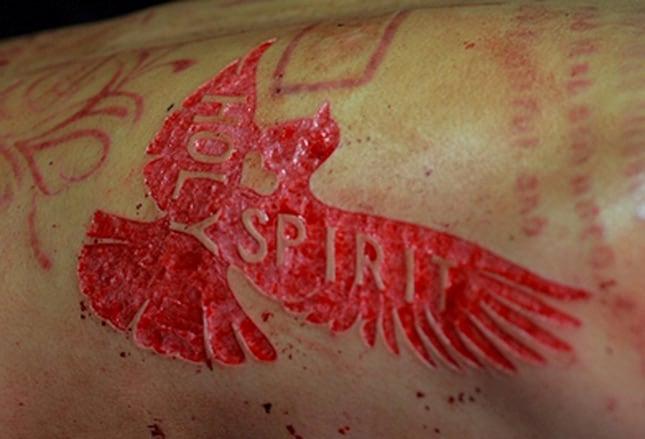
Man branding and abrasion are both considered scarification procedures fifty-fifty though they are typically associated with surgical instruments such as scalpels and other cutting instruments. The procedures of cut and electrosurgical branding (also known as light amplification by stimulated emission of radiation branding) have go some of the most popular scarification methods in the western world, equally they tend to provide the all-time cosmetic outcomes.
In terms of scarification methods, non every artist is practiced at all of them, and so if you're interested in having a specific method of scarification performed, be certain to do your homework to find an artist who makes use of that method. In the sections below, nosotros discuss each scarification method in detail, so that y'all can decide which i might suit your needs all-time. Still, you should besides consult with your chosen scarification artist to learn nigh the best way to implement your scarification pattern.
- Cutting. It is the process of carving designs into the peel using a scalpel or another sharp instrument. The process is not to be dislocated with self-mutilation, which refers to cutting for cocky-harm. In addition to cutting, other tools may be used to create scarification pieces. To darken scarification wounds, tattoo ink may sometimes be rubbed on. Alternatively, liquid skin adhesive can also be used to proceed a wound open, assuasive information technology to scar more deeply. The packed method is less common in western civilisation equally sanitation has made it difficult for the packing to be widely used. Cut scarification wounds in Africa and some other tribal cultures are often packed with dirt and ash to create significant hypertrophic scarring. To heighten the image of a cut pattern, the skin tin sometimes be peeled away; even so, skinning can lead to scarifying pieces that have inconsistencies in texture. Some artists use a cut technique known as hatching to create larger scarifications or designs that characteristic varied shading levels. This technique is like to sketching—although it is done with a scalpel.
- Skin removal/skinning. A unmarried line of cutting produces relatively sparse scars, whereas pare removal provides a larger area of scar tissue. To remove the peel, the outline of the area has to exist cut, and then the skin has to be peeled away. A scar left from this method unremarkably has an inconsistent texture, though this heavily depends on the creative person's skill and the person's aftercare.
- Packing . Traditionally, this method is used in Africa but is rare in the West. In add-on to a diagonal cut, an inert cloth such as clay or ash is placed inside the wound during healing. Massive massive massive mass hypertrophic scarring occurs during wound healing when contaminants inserted into the wound are pushed out. In the Us, cigar ash tin can be used for scars that are more raised and royal; people can besides employ ashes from their recently deceased relatives and friends.
- Hatching . The scarification method resembles flesh removal in that information technology is performed by cutting into the skin with a sterile surgical scalpel. Scarring a larger surface area requires the use of the hatching technique, which is similar to the procedure for sketching. This method is easier to perform than flesh removal, and it tin can be performed with just one paw, which may be advantageous in some situations. Although this technique can take a while for larger pieces, it is useful, especially for smaller, more detailed pieces. In addition, shading tin be applied.
- Strike Branding. A make is a metal slice heated on an iron that is pressed into a person's pare to class a design, similar the branding of livestock. For creating permanent body art, strike branding isn't the best option since the scars aren't as precise as other scarification methods. As well as spreading greatly during healing, the pattern can interact with the torso. Curvier torso parts are not recommended for this selection. When choosing this method, your artist volition be able to achieve meliorate results if he or she uses multi-strike branding. Multi-strike branding involves applying heated metal to the skin in stages to create designs rather than applying an entire design at once.
- Cold Branding. This method involves the freezing of a metal object to burn a design into a person's peel in a similar way to strike branding, but a nitrogen-based tool is used instead of a heated or flame tool to charge the iron. In dissimilarity to strike branding, cold branding ordinarily results in white hair growing back over the branded area. This form of branding also is less likely to cause keloids.
- Cautery Branding. This involves burning an artistic design into a person'due south pare with a thermal cautery tool. Long-term results are often ameliorate with this method as opposed to single- or multi-strikes.
- Electrosurgical Branding. In essence, information technology is a type of burning technology that uses hand-held electric devices that generate electric sparks that render the skin vaporous on contact. Even though there is typically no medical light amplification by stimulated emission of radiation involved in the procedure, laser branding is often referred to as such. This method of scarification is very precise and tends to be less dissentious to surrounding tissues than traditional scarification, resulting in a quicker and less painful recovery procedure.
- Abrasion. This is the procedure of creating scars by abrading the skin in layers with another device, like sandpaper or an inkless tattoo machine.
- Moxabustion. Using corrosive chemicals, removes skin and leaves scars. It consists of placing incense on the peel and allowing it to burn until information technology is extinguished.
- Electrosurgery. Like to electrocautery, it uses a device to laissez passer electricity directly through the pare of the patient to burn the skin. Hyfrecator branding is likewise called hyfrecator branding.
- Chemic Scarification. A method that removes skin and causes scarring by using corrosive chemicals.
- Electrocautery. Thermal cautery uses a heating element that can reach upwardly to 2000 degrees Fahrenheit in an instant, creating a tertiary-caste fire. A more intricate design can exist produced using this method, and curved lines are more than easily accomplished.
What to Know Before Getting Scarified
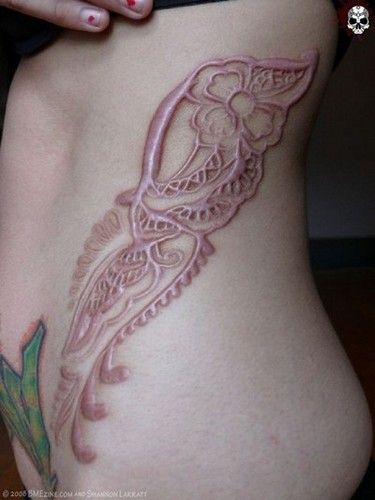
Every scar changes over time, irrespective of the technique. In time, your scars will fade and your peel tone will go closer to your natural 1. In contrast to a tattoo, healed scars volition always have different appearances, some will exist flat and some will be raised. The scars yous go from body modifications should heal consistently if you lot follow four basic principles, says Blair McLean, who proficient scarification for more xx years.
A not bad bargain depends on the creative person's skill to determine your scar's consistency. For a tattoo, several factors—such as the creative person's skill level, the depth of the needle, and the consistency of their work—will take into account how your scars look after healing. Finding an creative person whose scarring you tin can trust and who has been practicing this process for some time is important. It volition be possible to check their portfolio to meet whether scarring is done safely and correctly. Another good sign is an creative person who is familiar with the history of the practice since they will be able to provide both a detailed knowledge of the technique and an understanding of its cultural bear upon.
Finding A Scarification Artist
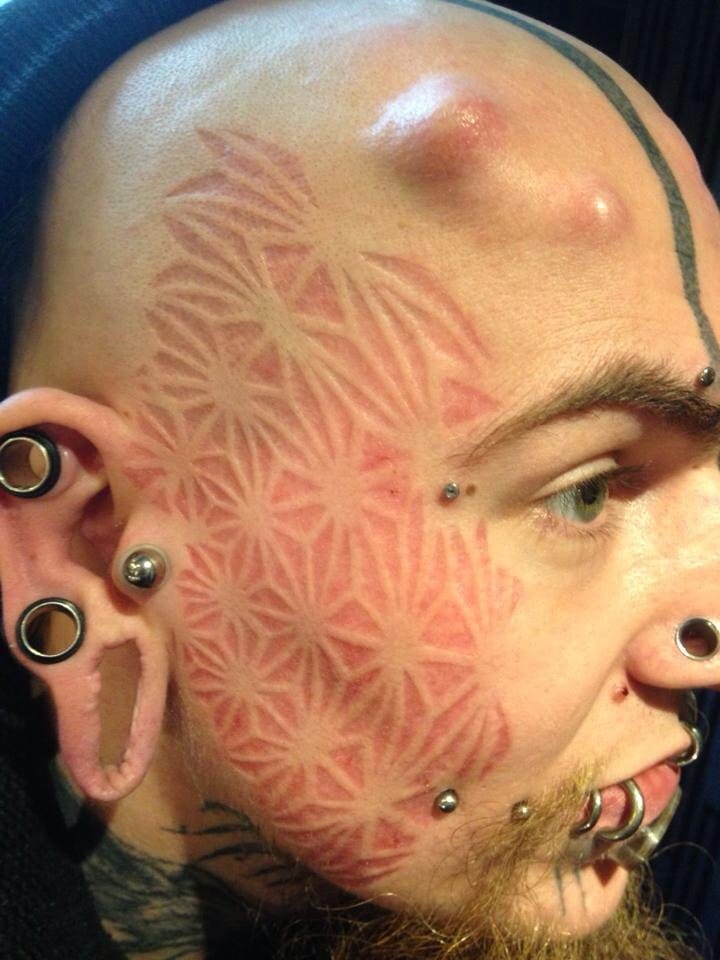
Before getting scarified, information technology is important to advisedly inquiry scarification artists to observe 1 who is experienced and has a skilful reputation. Information technology may be necessary to travel a distance to visit a reputable scarification artist since this grade of body modification isn't as widespread every bit tattoos or piercings, but information technology'southward well worth the try if yous tin find i. Consider checking out local tattoos and piercing shops in your area to meet if at that place are whatever that hire a scarification creative person or a piercer who likewise does scarification. In the case that yous are unable to find a scarification creative person locally, consider searching in your land or nearby states. Another choice would be to search for traveling scarification artists who might be participating in upcoming exhibitions in your neighborhood.
You lot should search for candidates and await through their portfolios, paying special attention to pictures of fully healed scarifications they have done to ensure the work is of high quality and volition heal well. Alternatively, you lot can also read artist reviews and talk to members of our online community through our forum to meet if anyone has recommendations for the artists you are looking at. Make your final decision after talking to two of your top choices for scarification, so narrow the field to two artists who perform the best scarification work. You may want to consider hiring the scarification artist whose work y'all enjoy virtually, whose skills and knowledge you find virtually supportive of your goals, and who tin can answer all your questions most scarification and aftercare.
Amplifying Scarification Designs
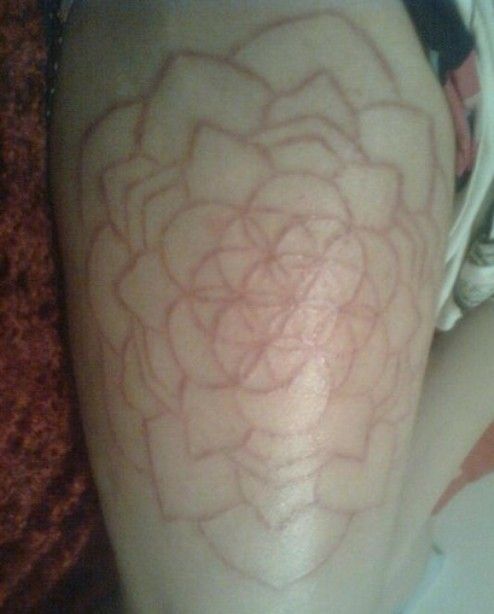
To obtain a scarification pattern that is as pronounced equally possible, you and your creative person tin apply a variety of techniques. Scarification methods play a role in the consequence of scarification, so you should talk to your artist earlier s/he starts working on your scarification piece. Generally, cautery branding, electrosurgical branding, and cutting are the most effective methods of branding. Be sure you like the way your artist's healing piece of work looks before you go on. If your chosen artist uses a different method, don't proceed until you are satisfied.
If your creative person uses a scarification method that uses liquid pare agglutinative, information technology may not exist possible to fill the scarification design with DermaBond to go on the wounds open and generate more than pronounced hypertrophic scarring. If you want a more significant healed scarification pattern, you can also apply an irritant such as toasted sesame oil or antibiotic ointment mixed with granulated sugar on your scarification piece at home during the kickoff 4-10 days of the healing process. If your creative person recommends using an irritating technique, you volition be able to ask for their recommendation. If you cull to use an irritant at the appropriate stage, always use it in the same direction in which the cut or burn down was created to forestall uneven scarring. You should also wrap your scarification piece with plastic wrap similar Precision Medical Cling Movie Wrap for the beginning vii to ten days later getting scarified, and seal it off with medical tape after cleaning the wound. If you lot do this, your wound will be kept from receiving oxygen and you lot will be able to slow downwards the healing process and attain optimal results. Here are additional suggestions about caring for a new scarification piece nosotros take included in our Scarification Aftercare Tips.
Warnings and Potential Complications

The scarification process tin only exist dulled by topical anesthetics since only scarification artists practice scarification instead of medical personnel. When information technology comes to body modification, scarification may not be the best pick for people with low pain thresholds. For those with low pain thresholds, applying a topical anesthetic like Dr. Numb or Derma Numb 20-30 minutes before scarification and repeating the awarding periodically throughout the process can brand information technology much more than bearable.
Risky practise, scarification damages the pare during the early healing stages and encourages recurring trauma, which causes the pare to deteriorate. Scarification artists need to be efficient, use sterile tools, wear protective equipment such every bit masks and gloves, maintain a make clean environment, and understand human beefcake to ensure your skin is not damaged across what'southward necessary to create the piece. The creative person could cause harmful results to your visual appearance and maybe put your health at hazard if they were to cut or burn your tissue too deeply or for too long. You'll also need to practice calm religious scarification aftercare to minimize your chances of developing an infection and to achieve the most even hypertrophic scarring.
Remember: If y'all are prone to keloid scarring or you are unsure, merely know someone in your immediate family unit is decumbent to developing keloids effectually wounds, be extra conscientious when getting scarified. By scarification, one can produce controlled hypertrophic (raised) scars according to a set up pattern. Hypertrophic scarring heals as fairly pare-tone scarring immediately around wounds, whereas keloid scarring grows out of command, forming a lumpy mound of taut, purplish-red scars that extend well beyond the intended wound site. Keloidal scarring tin can destroy the scarification blueprint and leave you with unsightly scars that require the help of a dermatologist then that the backlog scar tissue can be treated using cryotherapy, laser therapy, surgical removal, or corticosteroid injections. Scarification should not exist the but grade of body modification avoided past those prone to keloids.
Scarification Aftercare
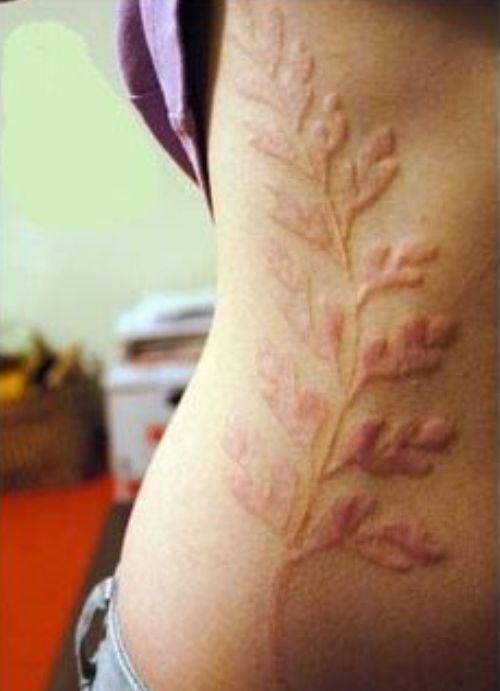
The second principle is that tattoo aftercare should be almost the opposite of the usual tattoo process. The principal reason for scarification might be to keep the scar abroad from possible irritation. However, this may really lead to the scar being disturbed. Information technology is important for people who don't desire their scars to heal flat that they irritate the wound to ensure that the scar will be raised. In some cases, still, scar tissue will form so thickly during healing that it will not lay apartment, making irritation during the healing process unnecessary. Some types of wearable can irritate scars, so they may heal unevenly in areas where their peel is rubbed confronting them. It is important to apply irritation uniformly to your blueprint then it heals consistently. If you lot pick at a scar, remember to launder your hands thoroughly and use only safe drugstore products. Most chiefly, keep your scar clean! Nada will make your new blueprint look bad similar forgetting to clean it regularly since it can become infected.
Tertiary, consider the placement of scars when having them done. A major component of scarification involves the pare. Dissimilar parts of your torso react differently to scarification. Depending on the type of skin, it tin range from very sparse and smooth to very thick and rough. It tin can be difficult for people who tend to scar easily to become a consistent design if they place information technology on skin that has inconsistent thickness (i.e. skin that is thick in some places and sparse in others). Information technology is generally best to place scars where the skin of the entire surface area is of equal thickness or roughness.
The last cistron to consider when contemplating scarification is your own genetics. The manner scars heal on your body is heavily influenced by genetics. If you lot have a particular genetic makeup or peel tone, your artist may change their scarification technique to improve suit you. When information technology comes to scarification, it is of import to interact straight with your artist and discuss non only the design merely how they program on implementing it as well. Information technology'due south all well-nigh communication to make sure you lot are comfortable and that y'all're satisfied with the results because every artist is different.
In an advisory YouTube video, McLean says that a person'south scarring ability is not always known; they may or may not have previous scars that could assist in identifying their scarring capabilities. It is important that a scar non only looks beautiful to the client and is articulate and easy to see years down the road, but it also stays flat or raised.
Immediate Postal service Scarifciation Aftercare
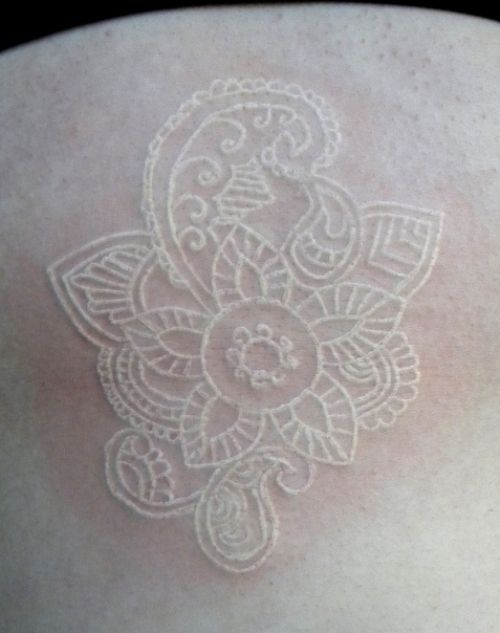
Bandages need to be inverse inside the first six to twelve hours after scarification. Here are the steps you should follow:
- Before touching your bandages, make sure your easily are thoroughly clean with a bar of antibacterial lather, then dry them with a clean paper towel. If y'all tin, clothing medical gloves every bit well. It is definitely a good idea for you or anyone helping you to clothing gloves.
- Y'all should throw the bandages abroad after removing them carefully.
- You should first smear some antibacterial soap on your palm. Something like H2Ocean's Cipher pain-relieving cream lather is ideal because it contains an anesthetic that volition relieve the discomfort of washing your scarification wound. Past rubbing your hands together and adding a small amount of water, you can lather up the soap and apply it to the scarification wounds in a direction that is in line with where the cut or burn down was created. Always avert using brushes or loofahs to scrub your scarification wounds since these things could cause uneven scarring.
- Lather up your scarification wounds and then thoroughly launder off whatsoever soap y'all used.
- With a make clean, fresh cotton fiber towel or newspaper towel, gently pat your skin dry. Before applying bandages, make sure your pare is dry. (Do not reuse cotton towels before washing them.) Your bandages will stay on properly if your pare is completely dry before proceeding.
- A thin layer of antibody ointment should exist applied to scarification wounds, such every bit A&D ointment or a triple antibody ointment. In the same way that you practical the soap, also apply the antibody ointment in the same direction that the scars were created.
- Don't wrap your scarification wounds too tightly. Instead, cover them with a thin canvas of plastic moving picture, similar Precision Medical Cling Picture Wrap. The edges should be sealed off with medical tape. When you cast your wounds, you keep the surface area nether the plastic wrap moist, which delays the healing process.
Post-obit these steps twice a twenty-four hours will speed up the healing process during the outset three days.
Scarification Aftercare After Days 3-x
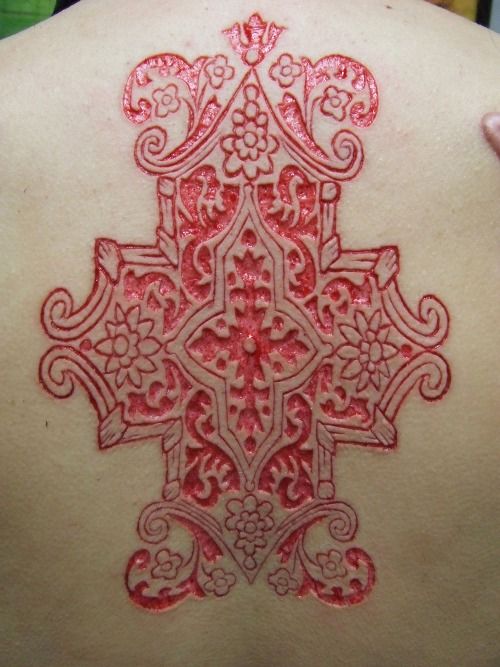
Scarification should be at this bespeak in the healing process when new tissue is developing. To avoid infection from forming on your scarification wounds equally new tissue forms, you should clean them twice a mean solar day. Wash your wounds with antibacterial lather past manus, in the direction that the wounds were created. You lot should not scrub your wounds at this stage with any kind of castor or loofah, since doing so volition cause uneven scarring.
Afterward your scarification wounds have been done and dried, you can begin incorporating an irritant at this signal, if your artist recommends information technology. An irritant will contribute to the production of more scar tissue, which will enhance the appearance of the healed scarification design. Sesame oil that has been toasted is an excellent tool for making healing tissue stronger, while also maintaining moisture. Toasted sesame oil tin can be used to replace antibiotic ointment earlier roofing scarification wounds with plastic wrap. To brand toasted sesame oil comparable to antibiotic ointment, you lot tin add a minor amount of sugar to petroleum jelly or antibiotic ointment. If you rub in whatsoever irritant you use against the grain instead of in the same direction as your wounds, you volition support your body's natural power to generate smoother, more than attractive scars.
When yous have finished your twice-daily cleanings, wrap the wounds with plastic wrap and close them with medical tape. Go along your wounds from becoming too swollen, though. Scarification wounds that are sealed off will brand your body produce more scar tissue instead of healthy, healthy skin cells.
Scarification Procedure After the 1st 10 Days
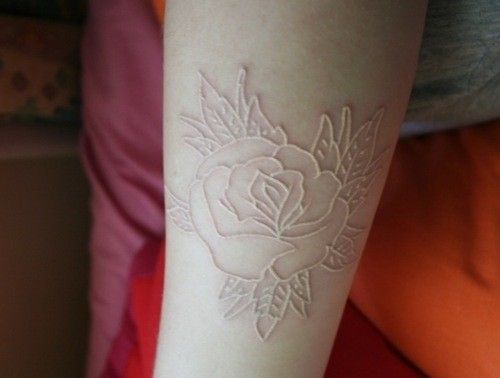
In the first ten days after having your scars scarified, you should discontinue using irritants and bandages. This will permit your wounds to begin to heal and form scabs. Make sure y'all clean your wounds carefully so as non to disrupt the scabs that have formed. As much as possible, you should avoid angle and motility the scabbed area of your body to prevent information technology from breaking. Also, minimize your motility to prevent the scabs from nifty. Wear loose, comfy vesture that will not press against or otherwise irritate your scarification piece.
Afterwards getting a scarification piece, your body should have produced enough scar tissue to completely encompass the wound within six weeks. If you desire to heighten your scarring, you can scratch your scarification wounds or irritate them with your hands. Whenever you lot do this, make sure you lot do it consistently across all of your scarification designs to ensure uniform scar formation.
Individuals will develop different degrees of scarring because of genetics, but adhering to the guidelines tin can positively bear on the upshot of your healed scarring piece. You can also touch on your outcome past how you apply a scarification pattern. Scarification pieces should not exist applied to parts of the body that movement constantly, like the knees, elbows, and waistline, since it will exist difficult to minimize movement in these areas sufficiently enough to prevent scabs from breaking upwards during the healing procedure.
Problems During The Scarification Healing Process
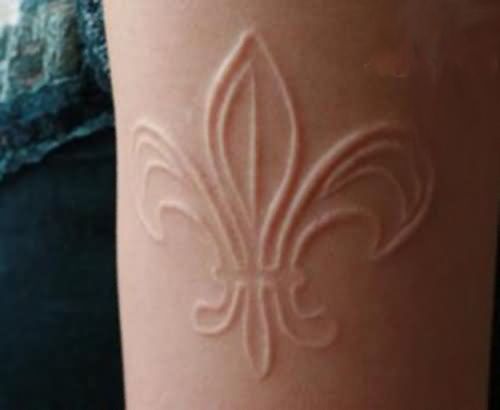
At that place is ever the adventure of an infection developing in a scarification piece because it is a wound. When you're at the highest risk for getting an infection during the early days of the scarification healing procedure, y'all may want to ask your physician to prescribe an antibiotic equally safety handling. Continue an eye out for signs of infection if you do not take an antibiotic prophylactically to ensure y'all tin can human activity promptly if y'all doubtable you are getting sick. Symptoms of infection include the appearance of thick, yellowish pus instead of claret (the clear fluid that wounds typically secrete later on healing that dries to a crust), red streaks radiating from scarification wounds, hot to the touch pare, and fever. When you experience whatever combination of these symptoms, you should contact your family unit doctor right away and ask almost antibiotics. You should complete the course if prescribed. In that case, a stronger infection will return and become resistant to antibody intervention. Do not cutting corners when taking antibiotics.
Information technology is also possible to experience skin discoloration around scarification wounds, tenderness, swelling, some bleeding, bruising, and/or itching during the healing process. All of these reactions are part of the natural healing process after trauma. Every bit a preventative measure, you can reduce bruising and swelling by taking acetaminophen (eastward.one thousand. Tylenol) instead of ibuprofen and applying common cold compresses to your bandaged scarification wounds. Before applying an ice pack to your wounds, wrap it in a make clean towel, and don't leave information technology on for longer than 10 minutes at a time. During the first six weeks, practice not scratch the scarification wounds straight if yous experience astringent itchiness, equally doing and so may cause uneven scarring. When you scratch your wounds or slap at bandaged wounds, you will save the itching.
If you feel any securely worrying problems, such as excessive swelling or indications of infection, speak to your scarification professional. Your physician may take boosted suggestions for y'all to attempt to resolve the problem, or he or she may recommend having medical care administered.
Source: https://bodyartguru.com/scarification/
0 Response to "Scarification: All That You Need To Know"
Post a Comment